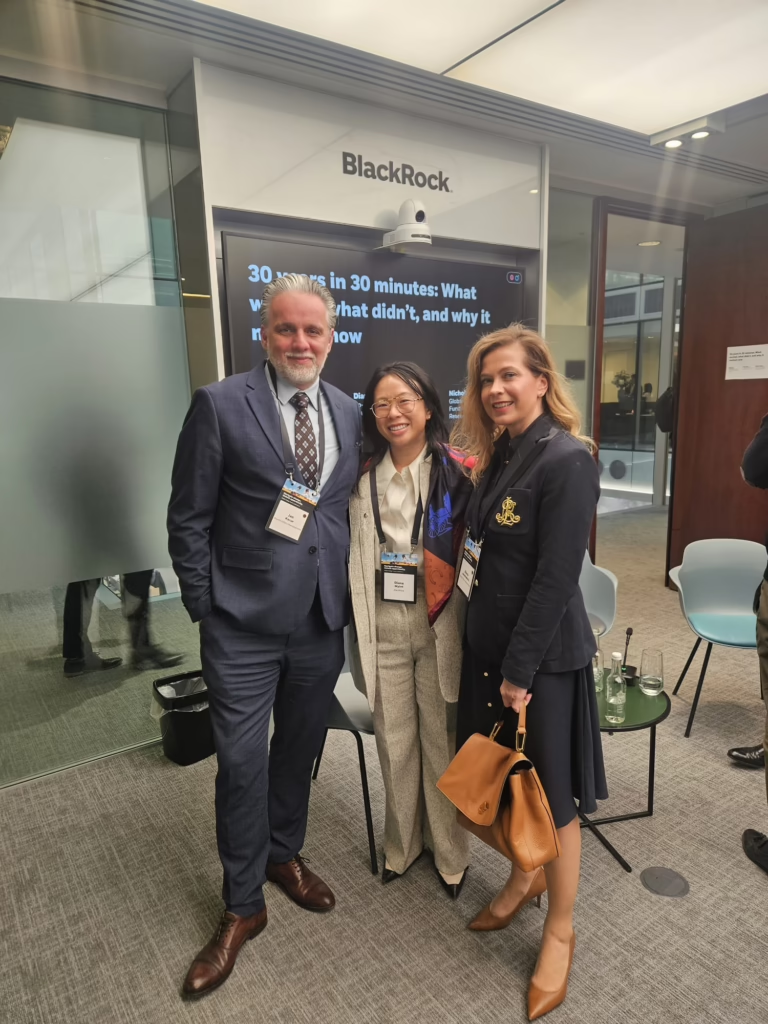

One of the more revealing moments during the EMEA Hedge Fund Conference 2026 hosted by BlackRock in London was not a discussion about performance itself. It was a simple slide comparing hedge fund launches and liquidations over time. The conclusion was difficult to ignore: most hedge funds do not survive long-term.
This reality is often overlooked — because the industry naturally concentrates attention on successful outliers. The winners become highly visible, while unsuccessful strategies disappear quietly in the background.
Yet the survival rate itself may be one of the most important insights in active investing.
Naturally, investment management is not only about generating returns. It is about sustaining a repeatable process across market environments and periods of uncertainty.
Most strategies perform well during favourable market conditions. Far fewer remain disciplined during prolonged drawdowns, liquidity shocks, macro regime changes, or periods where consensus positioning suddenly reverses.
This became particularly relevant in the context of broader discussions around resilience, volatility, and geopolitical uncertainty during the conference, including perspectives shared by Mike Pyle as well as during the session “An Age of Conflict: Europe’s Strategic Reality”.
One important distinction became increasingly clear:
Markets rarely destroy investment organisations overnight. More often, deterioration begins internally — through process inconsistency, uncontrolled risk concentration, behavioural pressure, style drift, or the inability to adapt without abandoning discipline altogether.
This is where the difference between short-term performance and long-term survival becomes visible.
The most durable investment companies are rarely those pursuing maximum short-term returns at any cost. More often, they are the ones able to preserve process integrity, manage volatility responsibly, and continue operating rationally under stress.
In this sense, resilience itself becomes a form of investment edge.
For clients, this distinction matters — and that significantly.
Because the true quality of an investment manager is rarely revealed during easy markets. It becomes visible during periods where uncertainty tests the stability of the entire framework behind the portfolio.
At Wealth Effect Management, we believe this perspective is becoming increasingly important in modern portfolio management.
Not only how returns are generated. But how the process behind them survives over time.
Because short-term return might be fancy — but an enduring family wealth and legacy require looking (far) beyond the next quarter.