Global Wealth Management Summit 5–6 November 2025 — 2/3
The greatest tension in modern wealth management is not between banks and family offices — but between intention and incentives.
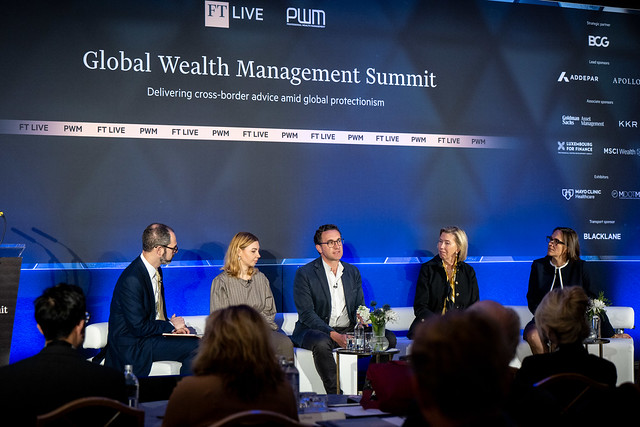
At the Financial Times Global Wealth Summit in London, one moment captured this divide with absolute clarity. It came from Nicole Curti (CEO Capital Y) — and the room quietly agreed.
Her comments reflected the true mood of the event:
while many banks spoke about technology as a tool to increase adviser productivity and profits — rarely mentioning clients — every family office in the room focused on something entirely different.
They saw technology as a way to increase the time advisers can actually spend with their clients.
Two industries.
Two philosophies.
Two interpretations of the same tool.
Banks optimise scale — distribution, efficiency, throughput.
Family offices optimise depth — understanding, alignment, presence.
This contrast was not confrontational.
It was observational.
And it revealed a fundamental truth about the future of wealth: Technology will not standardize relationships. It will expose them.
It will show which firms use digitalisation to shield themselves from clients — and which use it to move closer to them.
It will show who is building processes around products — and who is building processes around people.
The rise of family offices is not driven by higher returns, exotic assets or niche specialisation.
It is driven by something far simpler:
Time.
Attention.
Alignment.
Families are not looking for more touchpoints.
They are looking for the right touchpoints.
They are not asking for better dashboards.
They are asking for better decisions.
They do not measure service by output — but by presence.
The industry speaks often about innovation.
But the real innovation is not technological.
It is relational.
The firms that will lead the next decade are not those that automate the most — but those that automate wisely, so their advisers can return to the one thing no machine can replicate:
– human connection,
– client understanding,
– and the quiet discipline of meaningful service.
AI is reshaping wealth management — but not in the way the hype suggests.
At the Financial Times Global Wealth Management Summit in London, one message resonated across the panels:
AI is not a catalyst for speed.
It is a catalyst for depth.
Speakers agreed on a simple truth — the biggest misconception in the industry is the belief that AI will replace advisors, judgment or relationships. In reality, it will only expose who truly understands clients — and who has been hiding behind processes.
AI will not take over advisory work.
AI will reveal the quality of advisory work.
The real transformation isn’t happening in chatbots, but in three core areas:
1. Decision Intelligence
AI does not build portfolios.
AI illuminates what humans often miss: risk patterns, inconsistencies, behavioural shifts.
Decision-making becomes less about intuition — and more about clean, structured insight.
2. Hyper-personalisation
Not “segments,” but the actual life patterns of families: mobility, liquidity cycles, values, generational transitions. AI can anticipate future needs before a family articulates them.
3. Prevention, not reaction
Risk management will no longer be retrospective. AI shifts control toward foresight — especially in complex structures, private assets and multi-jurisdictional portfolios.
But the most powerful insight from the summit was this:
Technology solves nothing by itself.
It only amplifies the people who use it.
Firms that expect AI to fix their internal disorder will simply accelerate the chaos.
Firms that already operate with discipline, strong infrastructure and clean data — will see their capabilities multiplied.
This is becoming the new competitive frontier in wealth management: the courage to examine one’s own processes without illusions. And rebuild them where necessary.
AI is not bringing a product revolution.
It is bringing a transparency revolution.
And transparency will distinguish those who build wealth with integrity from those who build illusions.
The future belongs to firms that keep their humanity — and use AI to amplify quality, not noise.
Diana Janošťáková
Head of Operations,
Wealth Effect Management