Words, AI, or portfolios alone won’t make you a wealth manager.
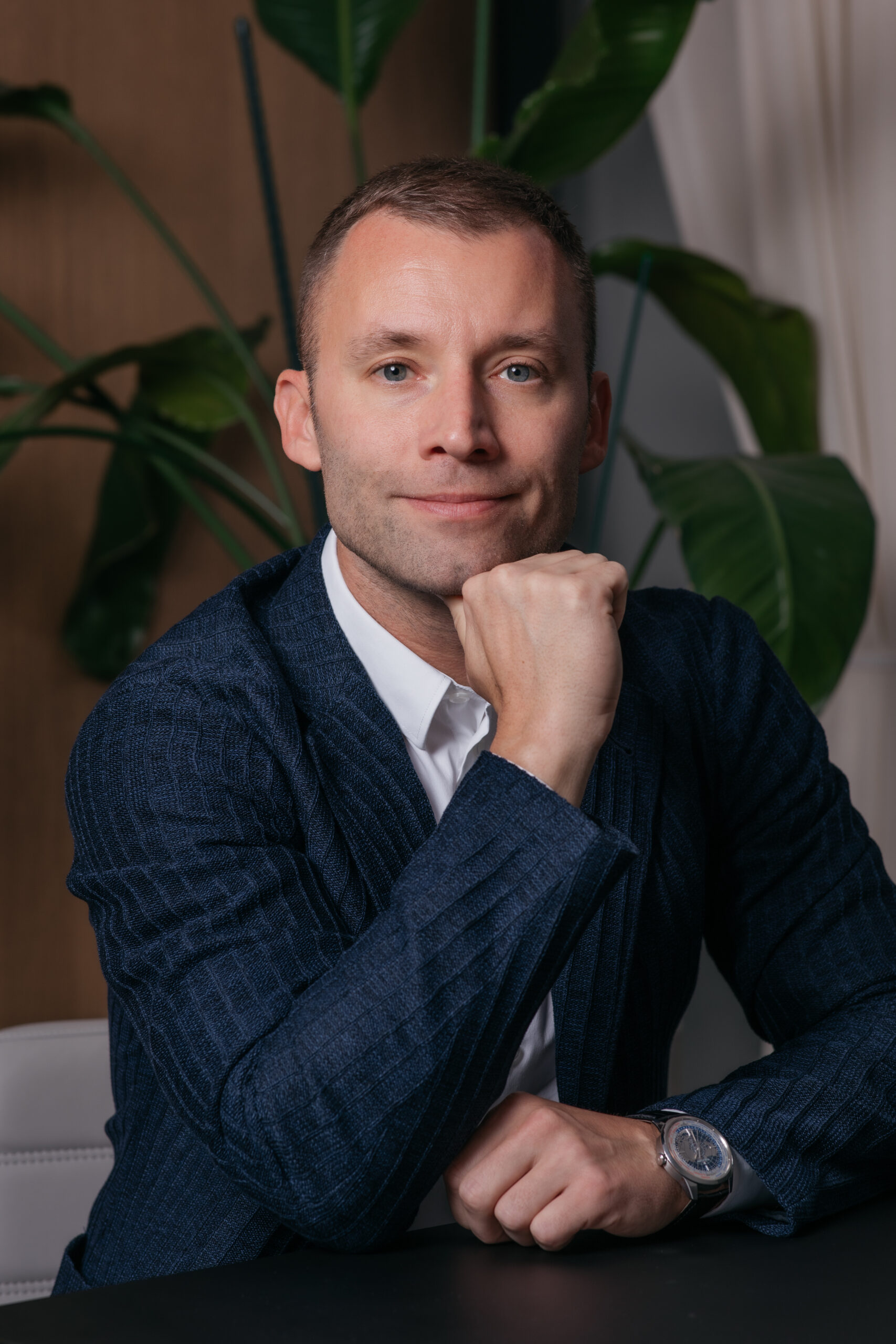
“Wealth management” is becoming an increasingly common term. And as with any new trend, it
creates a race to capture as much market share as possible, as well as vast differences in quality and approach. For more on wealth management — its substance, complexity, and forms — see the below interview with one of the longest-standing players on the Slovak market: Peter Štadler, CEO of Wealth Effect Management.
Let’s start at the beginning — what actually is “wealth management,” and how does it differ from trading or traditional
financial advisory services as most people know them?
Put simply, wealth management is comprehensive management of assets that includes a wide range of services — from investment-related ones to business, legal, tax, accounting, all the way to concierge and lifestyle services.
Last but not least, true wealth management, actually, only comes into play when all of the above evolves into a relationship of a trusted companion — whether it’s a companion to a wealthy individual or entire families.
Trading or standard financial advisory services therefore cover, or may cover, only one dimension of comprehensive wealth management — and even that only partially. Moreover, from a wealth management perspective, they cover it insufficiently.
Could you elaborate on that a bit?
Trading or financial advisory services typically have a single goal — to build or grow wealth. While this may sound surprising at first, for the true target group of wealth management services, this is actually not the most important aspect.
To explain: Wealth management, as it is understood in developed Western economies — and as we understand and practice it at Wealth Effect Management — is not intended for everyone. In its full form, it only truly makes sense for audiences referred to as HNWI (High Net-Worth Individuals) or UHNWI (Ultra High Net-Worth Individuals). The standard definition sets the entry threshold for HNWI at approximately USD 1 – 5 million in liquid, investable assets. For UHNWI, it starts at USD 30 million.
HNWI and UHNWI clients no longer need to “build” wealth — that phase is done. And while further growth remains relevant and important, it is not the primary concern.
What, then, is the priority for ultra-wealthy individuals and families?
Other dimensions come to the forefront — how to protect and secure wealth? How to diversify it properly? In the case of families, the situation is even more complex, as questions arise around the correct setup of family office structures, foundations, trusts, and similar vehicles.
Not to mention that as the generation of affluent individuals and families ages, the question of transfer becomes increasingly important. How to properly transfer wealth and preserve it for future generations? People can learn more about this on our current website, although a renewed version will be launched soon.
As you can see, these are not the areas that regular traders or financial advisors could — or would be able to — address. And even with this complexity, we are still only talking about one dimension — the one directly related to finances themselves.
What do the other areas of wealth management include?
These are areas that gradually move away from wealth itself toward what wealth enables — from highly complex legal, tax, and accounting advisory services, through extensive and long-term preparation for wealth transfer, all the way to lifestyle partnerships at the level of very exclusive concierge services.
What can we imagine under these concierge services?
Almost anything. This is where affluent individuals look for — and find — creative ways to enjoy their acquired wealth and the opportunities it provides. The number of possibilities is as vast as is the range of ideas, preferences, and tastes.
To mention a few interesting examples, though: for some clients, we organized tastings of rare and essentially no longer available whiskies. For others, we secured limited reservations at top restaurants where the waiting list normally easily exceeds a year. We also arranged access for some of our clients to the Grand Sumo Tournament, which at the time had taken place outside Japan only for the third time in its entire history — at the Royal Albert Hall in London, no lessz.
We have also arranged ultra-luxury vacations, investments in collectible cars and jewelry, and many other exclusive requests that remain discreetly unmentioned.
This truly shows wealth management from a different perspective. From your point of view, what is key to being able to provide such services successfully over the long term?
Maturity.
In what sense? Could you expand on that?
Maturity means the ability to understand — and to deliver.
This ability only comes with a necessary amount of experience and invested time, and only if the individual or company is continuously improving and working hard.
Again, wealth management must be viewed in its proper context: when working with HNWI or UHNWI clients, you are working with individuals and families accustomed to an extreme level of comfort, opportunity, discretion, and quality. There is no room for fake glitter, empty talk, or empty promises — your word is an absolute commitment, and your discretion and capabilities are table stakes; exceptional qualities are not a bonus, but a cost of entry.
Understanding the crucial importance of time and reliability is the starting point. This is followed by your capacity to truly understand your client and perceive also that which remains unspoken. Closely after that comes your ability to find and execute a solution — which inevitably introduces another critical dimension: the need to have a strong network of partners and suppliers around you. High-quality, vetted, and reliable ones. None of this is obvious or easy. It requires a great deal of time, effort, self-reflection combined with a willingness and ability to learn and improve, many long days and nights — and also a great deal of humility.
Humility?
Necessarily. Humility is the simple realization that there is always something more you don’t know, something you haven’t encountered yet, new needs that must be addressed.
Unwarranted self-confidence is a ticket to trouble; humility keeps you alert and on your toes and enables continuous improvement — of yourself, your team, and the breadth and quality of your products, services, and opportunities.
Humility is therefore also a tool to avoid resting on your laurels and stagnating — another thing you simply cannot afford in high-stakes wealth management.
How do you view other entities on our market that have recently begun using the term “wealth management” at every opportunity?
With a smile and with interest. In most cases, I wish them well. Wealth management is not easy — at least not if you want to do it truly well.
Otherwise, of course, anyone can say whatever they want. One can only hope that the relevant audience does its homework and does not get caught solely by marketing or buzzwords.
So how do you differentiate yourselves from other players in this exceptionally demanding segment?
Through results, quality, and people — but not only through portfolio results. From our perspective, it’s actually quite simple: numbers alone don’t make you a wealth manager. Neither do words. Nor AI.
In essence, what makes you a wealth manager are your clients — their trust, long-term enduring relationships, your integrity, the quality, breadth, and credibility of your network, the complexity of your services, whether your clients recommend you further, and whether the range of what you can deliver for them continues to expand.
How much time you can save them, how many problems you can prevent. The scale of your competencies, how level-headed you are in crisis moments, how reliable you are, and whether you can be trusted.
All of this is extremely demanding and takes years. Years.
It is by no means something you can simply declare yourself to be and “become” within a few months, no matter how loudly or frequently you claim it. You become a wealth manager over a long time, and the longer you are one, the more you realize how much more there still is to cover.
Quality also means not only strict adherence to regulation, but also holding a full securities dealer license. Neither is nearly as standard in Slovakia as it should be.
And finally, people mean a continuous effort to recruit and further develop the very best. I can say with pride that today at WEM we already have top-tier professionals with experience from around the world — and it shows.
That is why I view the communication of other players in this business cautiously and with reserve. When two people say the same thing, it is not the same thing. Marketing can tolerate anything. People cannot. And HNWI / UHNWI clients least of all.
Make a misstep there, and you close the door not only to that individual or their family, but often to their entire network. You may never even hear about it explicitly — people will simply stop answering calls and messages.
That is also why I speak about humility — because in wealth management, you must balance two seemingly contradictory things: enough justified self-confidence to know you are doing exceptional work, and enough humility to realize you must always go further.
Wealth management is not a “get rich quick” scheme played in the short term. It is a long game — essentially a lifelong one. And you are not only playing for your name and reputation; you are also playing for your clients’ trust, security, wealth, and quality of life.
Let’s take a look at technology and its role in modern wealth management. How do you view the use of technology and the AI boom?
It is extremely important to use the right technologies correctly — and equally important to understand their limits. We ourselves use a range of technologies that save time and prepare data for decision-making, from the Bloomberg Terminal to various AI tools for research.
However, we have a fundamental rule — final conclusions and decisions are always made by a human — or a group of humans. That is why our Investment Committee includes people with different areas of expertise.
It would of course be foolish and irresponsible to ignore the benefits and value of technology. After all, our CTO, Norbert Gálik, is our internal technology wizard, and thanks to him we have made major strides forward in our client area, app, trading platform, and the B2B platform Flip.
What is your view on AI specifically?
It would be foolish and irresponsible not to be aware of where technology — including AI — has hard limits. Undoubtedly, AI works significantly faster than anyone on our team.
However, AI cannot ask questions. AI cannot sit with a client, perceive them, listen to what is said and unsaid, notice gaps or hesitation. It cannot have a human-to-human relationship.
No matter how you look at it, wealth management ultimately comes down to relationships. From that perspective, technology is excellent because it allows you to spend less time on what can be replaced or automated and gives you more time and capacity to focus on what cannot — such as being human.
You mentioned your own technologies. What are they
based on, and what is their goal?
There are several, but all stem from the understanding that it is our duty and responsibility toward our clients and partners to constantly seek new ways to save time, facilitate decision-making, increase comfort, and bring additional opportunities.
For our clients, we have created — and continuously improve — a mobile app and its desktop equivalent in the form of a client zone. There, clients not only have an always up-to-date overview of their investments and new opportunities, but can also use their WEM Benefit Card, which offers a range of benefits across various merchants and venues, from gastronomy to lifestyle. In the new year, we will also be adding a trading module to the app for those clients who want to try for themselves how it works and what results they can achieve when buying and selling securities independently (based on a commission agreement).
Looking ahead, we are also preparing gamification elements within the app and client zone, as well as a VR environment with advanced AI modules for automation — both for advisory services for (U)HNWI clients and for less affluent clientele.
For our partners and financial professionals, we created the Flip platform as the most modern all-in-one tool for managing investments and clients — but perhaps we can talk more about that another time.
Do you have any final words for people interested in
using wealth management services?
Choose carefully. A wealth manager should be a long-term, reliable partner who becomes deeply integrated into your life. Their value should be measured both by what they add — wealth, opportunities, peace of mind, time — and by what they remove — stress and unnecessary activities. Wealth management goes deep, and it is for the long term.
Originally published in Slovak on 18 December 2025 on the website trend.sk